

Taxation Without Representation - Part 1
- California electricity prices are a private-sector tax on a necessary of life

As a consequence of the wasteful California energy policies author Kerry Clapp highlights in his August 5, 2025 A Pragmatic Approach to Energy Substack post, “Desperate Response For the Losing Transition - Part 3: California’s Solar and Import,” the key paragraph documenting the wasteful energy policies is, …..Figure 4 (CAISO Real-Time Pricing) shows electricity prices at ~$35/MWh during imports and ~ negative $18/MWh during exports, reflecting oversupply. Figure 5 (Approximate Costs of Imports) estimates California paid ~$2 million for imports (57,287 MWh × $35/MWh) and incurred a ~$0.9 million loss exporting at negative prices (50,837 MWh × -$18/MWh), totaling a ~$2.9 million cost for the [single] day. Additionally, utilities [ratepayers] paid solar-equipped homeowners ~15–30 cents/kWh for excess power under Net Energy Metering (NEM) agreements, far above the negative export price, further inflating costs……

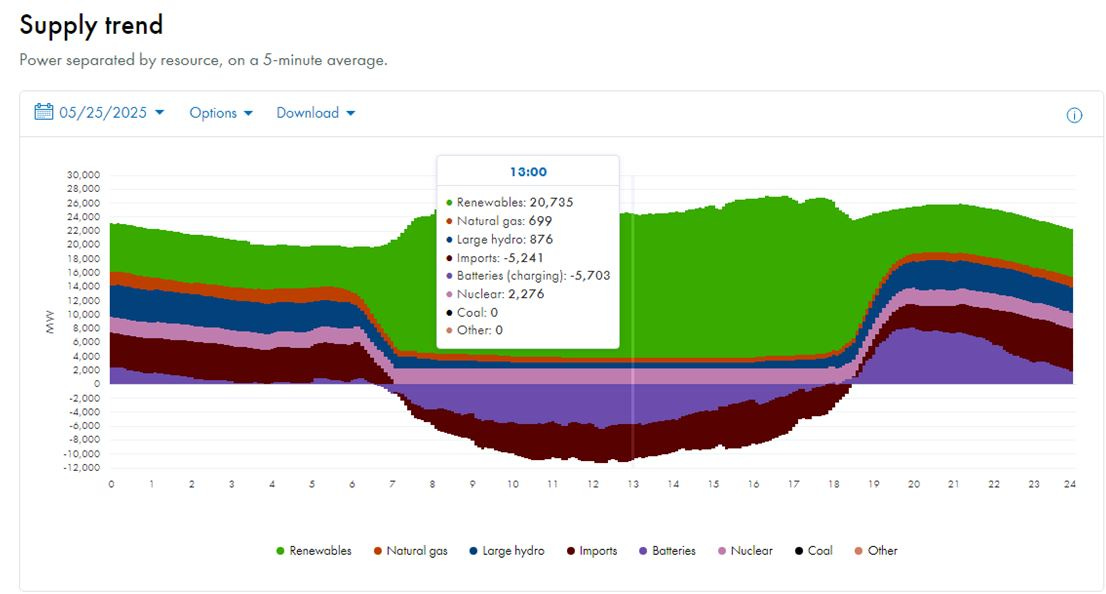
The CAISO Supply Trend for Sunday, May 25, 2025 that Bill McKibben is excited about shows many problems for ratepayers and the environment.
California's power rates are now typically the most expensive in the continental U.S. In March, 2025 California's average retail rate was 30.62 cents per kilowatt-hour (kWh,) almost twice the national average of 16.22 cents/ kWh. https://poweroutage.us/electricity-rates (Kerry cites 31.82 cents / kWh for California average residential rates. ) Per the U.S. EIA California’s total 2023 energy expenditures were $195 billion, the greatest of any state.
I believe one of the reasons for California’s electric power rates being the most expensive in the continental US is the forced adoption of the largest quantity of solar generation and grid-scale batteries of any U.S. state. (Texas has much more installed wind generation.) None of these technologies can reliably supply electric power 24/7, 365 days a year. Many power consumers, particularly businesses, require this high level of reliability. Also, none of these means of supplying electricity can supply meaningful amounts of an essential grid reliability service, synchronous grid inertia (SGI.) Here are the capacity statistics as of July 9, 2025 from the California Independent System Operator (CAISO) https://www.caiso.com/documents/key-statistics-jun-2025.pdf
Solar 21,240 MW
Wind 8,375 MW
Batteries 13,250 MW (as of June 30, 2025.)
Furthermore, a likely reason for this counterfactual adoption of these technologies, which represent a California ratepayer burden of tens of billions of dollars since 2010 is aggressive lobbying by special interests that benefit financially from those choices. One such special interest is Warren Buffett’s Berkshire Hathaway subsidiary, PacifiCorp. Until May, 2025, likely in response to a now-denied complaint originally submitted in May, 2025 by Californians for Green Nuclear Power (CGNP,) to the California Fair Political Practices Commission (FPPC,) PacifiCorp’s California lobbying expenditures were
Number 3 in 2034
Number 5 in 2023.
However, in May, 2025 PacifiCorp declared under penalty of perjury that those expenditures which in their original Form 635 Lobbying Disclosures totaled over $17 million dollars were amended to a mere $204,000.00
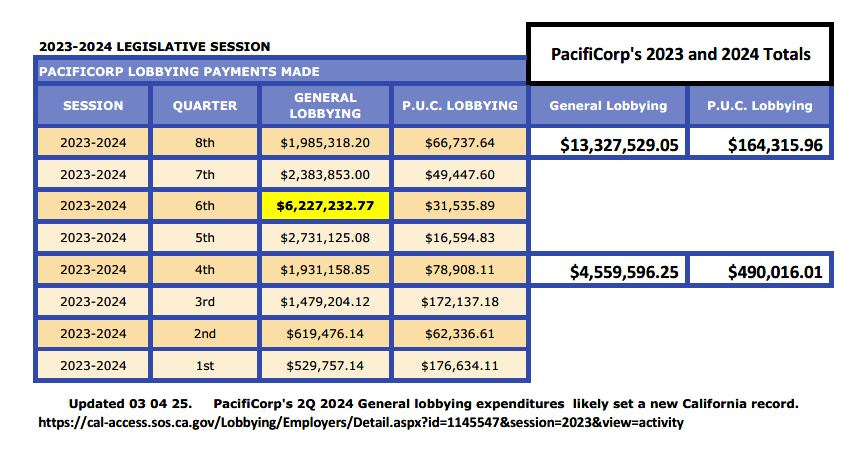
Here is the summary of PacifiCorp’s original Form 635 filings for 2023-2024.
CGNP is skeptical of PacifiCorp’s amendments. Late on August 5, 2025 CGNP filed a new 38-page Sworn FPPC Complaint COM-08062025-02463
Warren Buffett cynically declared Berkshire Hathaway’s rationale for wind generation with a 2014 quote in U.S. News and World Report at https://tinyurl.com/Buffett-Wind-Scam
"For example, on wind energy, we get a tax credit if we build a lot of wind farms. That's the only reason to build them. They don't make sense without the tax credit."
Apparently, Berkshire Hathaway has built a lot of wind farms.
Some physical principles related to California solar generation
On a cloudless day, the electricity output of a solar PV generator is greatest when the Sun is directly overhead. This was the time selected by CGNP. During Pacific Daylight Saving Time (PDT,) this time is close to 1:00 PM. During Pacific Standard Time (PST,) this time corresponds to noon. This specific time was selected for CGNP’s daily analysis of CAISO generation by source for the period from late October, 2024 through August 6, 2025.
The Sun’s position is highest on the first day of summer, approximately June 21, 2025. The summer position at 1:00 PM PDT on a cloudless day corresponds to the greatest output of a solar generator. On the other hand, the Sun’s position is about 47 degrees lower with respect to the horizon on the first day of winter, approximately December 21, 2024. The maximum output is at 12 noon, PST. Review of the daily California power exports at 1:00 PM PDT the almost three months between May 16, 2025 and August 6, 2025 shows significant exports caused by excess solar and wind generation above California’s needs on all days but two. On nine of those days, over 5,000 MW were being exported at 1:00 PM PDT. However, for the roughly two months between January 11, 2025 and November 10, 2024, there were no California power exports at 12 noon, PST. This seasonal variation is a consequence of the changed position of the Sun between summer and winter and the increased cloud cover during the winter months, which decreases solar power output.
The output of a solar PV generator is similar to a cosine squared curve with the maximum value at solar noon. By geometry, that implies on cloudless days that most of the power generated will occur between about 10:30 AM PDT and 3:30 PM PDT. As a consequence of “must take” provisions that are a component of renewable portfolio standard (RPS) legislation, the substantial intermittencies that are characteristic of solar and wind generation are filled in via fast-acting natural gas fired generation. See: "Turns out wind and solar have a secret friend: Natural gas," by Chris Mooney, August 11, 2016, The Washington Post, http://tinyurl.com/Natural-Gas-Secret Thus, California’s solar and wind generation requires a huge fleet of over 29,000 MW of associated natural gas-fired generation. No wonder natural gas interests are big fans of solar and wind!
Does the CPUC listen to most California ratepayers? Nope.
Since 2016, CGNP has been an intervenor in the public interest before the California Public Utilities Commission (CPUC.) CGNP employs arguments based on the principles of science, engineering, and economics. We have been vigorous participants in numerous hearings. We have filed thousands of pages of written testimony. The intervention process requires precise completion of numerous steps within rigid schedules. There are many unique elements to practicing before the CPUC. Our lead counsel is uniquely qualified as a former four-term California Assembly member. During his final term, he served as Chair of the Assembly Utilities and Energy Committee.
A keen legal mind is a necessary condition to be a successful CPUC practitioner. CGNP was required to fight the CPUC aggressively in conjunction with other nuclear advocates to obtain a mere five year extension to Diablo Canyon Power Plant (DCPP) operations. CGNP was the lone Party of fifty-five that advocated for DCPP extended operations in the CPUC Proceeding that ran from 2016 through early 2024. Even though the CPUC is responsible for a reliable California power grid, per a key statute in the California Public Utility Code, the CPUC has been avid supporters of intermittent, unreliable solar and wind generation. The CPUC appears to give significant weight to the opponents of nuclear power, which is consistent with the political Left’s perspective regarding nuclear power. CGNP believes that the objective of a safe, reliable, abundant and cost-effective electric power system which minimizes air and water pollution should be embraced by both political conservatives and political liberals.
On page 167 in Rebecca Tuhus-Dubrow’s 2025 book, Atomic Dreams - The New Nuclear Evangelists and the Fight for the future of Energy https://www.amazon.com/Atomic-Dreams-Nuclear-Evangelists-Future/dp/1643753150 she notes, “They (CGNP) wrote responses to the comments of other intervenors. All this added up to thousands of pages over the years. Heather (Hoff) and Kristin (Zaitz) sometimes smirked at Gene (Nelson’s) idiosyncrasies, but they ultimately expressed deep gratitude that he and his associates were doing the grunt work.”
Since the record shows that PacifiCorp has spent significant sums over the years directly lobbying the CPUC, the firm’s views likely find a receptive audience within the CPUC staff.
More to come in Part 2…
Supporting files are now available at the CGNP website. See:
https://cgnp.org/supporting-files-for-taxation-without-representation-08-07-25/
There is a detailed spreadsheet and six monthly SGI-capable supply stack charts showing natural gas-fired generation and generation from DCPP at solar noon for the months of March through August, 2025, inclusive. Part two will provide additional relevant background. CGNP will be focusing on the dangerously-low SGI-capable supply stacks at solar noon on May 3, 2025 and May 4, 2025. DCPP Unit 1 was undergoing a planned refueling and service outage at the time. On both days, each of the total SGI-capable supply stacks for the entire CAISO area were less than 2,000 MW. Shades of the Iberian Peninsula on the morning of Monday, April 28, 2025! CAISO seems to be much more conservative regarding the state’s SGI-capable supply stacks at solar noon during the ongoing DCPP curtailment associated with the almost 100,000 acre Gifford Fire, now the largest wildfire in the state with only 15% containment. This large fire straddles San Luis Obispo County and and Santa Barbara County.
Finally people are seeing that the renewable emperor has no power! The amount of storage required to make renewables work reliably is profound, since you need to squirrel away enough energy to cover both diurnal & seasonal fluctuations. And with the storage there needs to be a massive increase in renewable generation to fill the storage. I no longer live in California, but near were we live there is a 2.5GW coal fired generator that is planned for closure. The activist community was pressing for solar, when I ran the numbers I came up with needing 2.1TWh of storage. To back up one power plant. Contrast this with the 13GWh California has installed after 2 decades of trying.
A typo in the middle of the article showing PPW’s lobbying expenses for 2034. You no doubt meant 2024.